
illuminate history
Curiosity: forget “Cherchez la femme” (Look for the woman.) “Cherchez l’histoire.” (Look for the story.)
Veliko Tarnovo, Plovdiv–read these names aloud
Yes, I am delinquent on my last two trip reports.

There was more and more snow after we boarded the bus in Rousse and headed over the summit of the Balkan Mountains toward Veliko Tarnovo, ancient capital of Bulgaria.
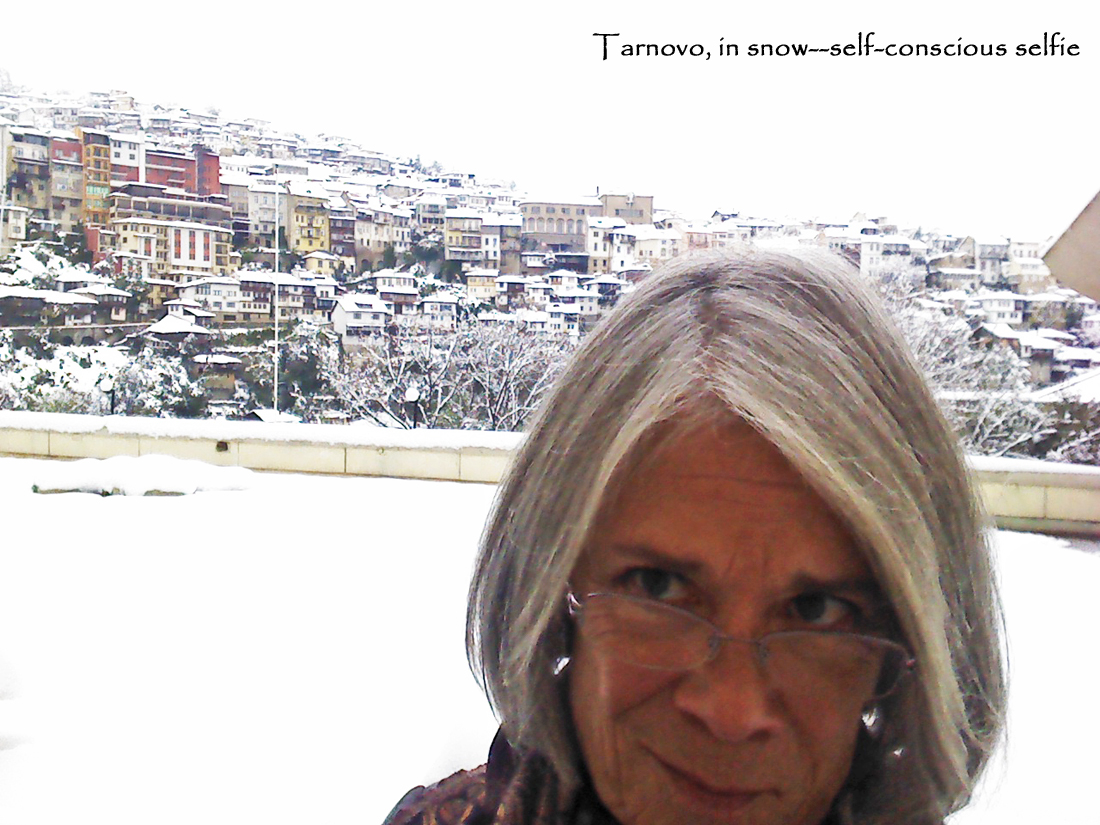
Archaeological records of settlements in this area date back more than 5,000 years. The town seems fairly prosperous–in part, I imagine, due to its appeal as a tourism and recreation destination. There are many hiking and skiing resorts nearby.
It was so icy that  we couldn’t go all the way out to the ancient castle, which dates back to the Crusades.Our guide said that Bertram of Flanders was captured and imprisoned here. Unfortunately, the King’s wife fell in love with him, so he was executed. I can’t find any corroborating evidence of this on the internet, but the fortified town has been here since the 12th century.

We did walk far enough to get a nice perspective on the town as we came back.
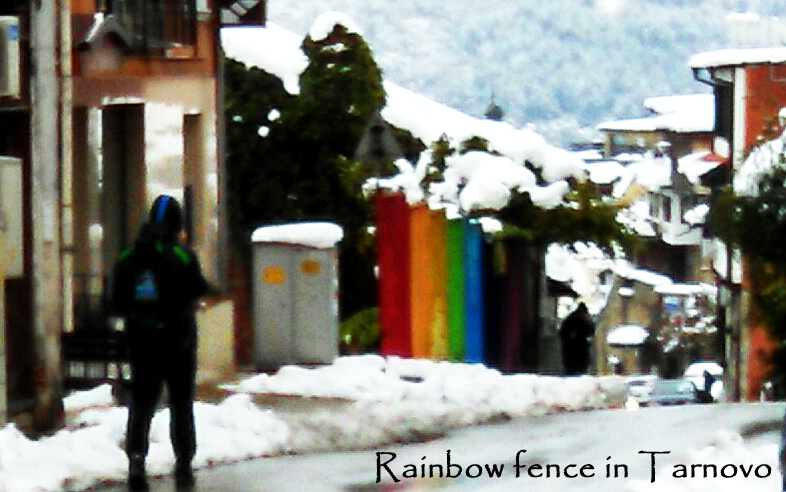 After finding a couple of cool souvenirs on the old craft street, I spotted a nice contemporary touch.

Wandering around a little after lunch, we saw a terrific mural–except that I have no idea what it’s about.
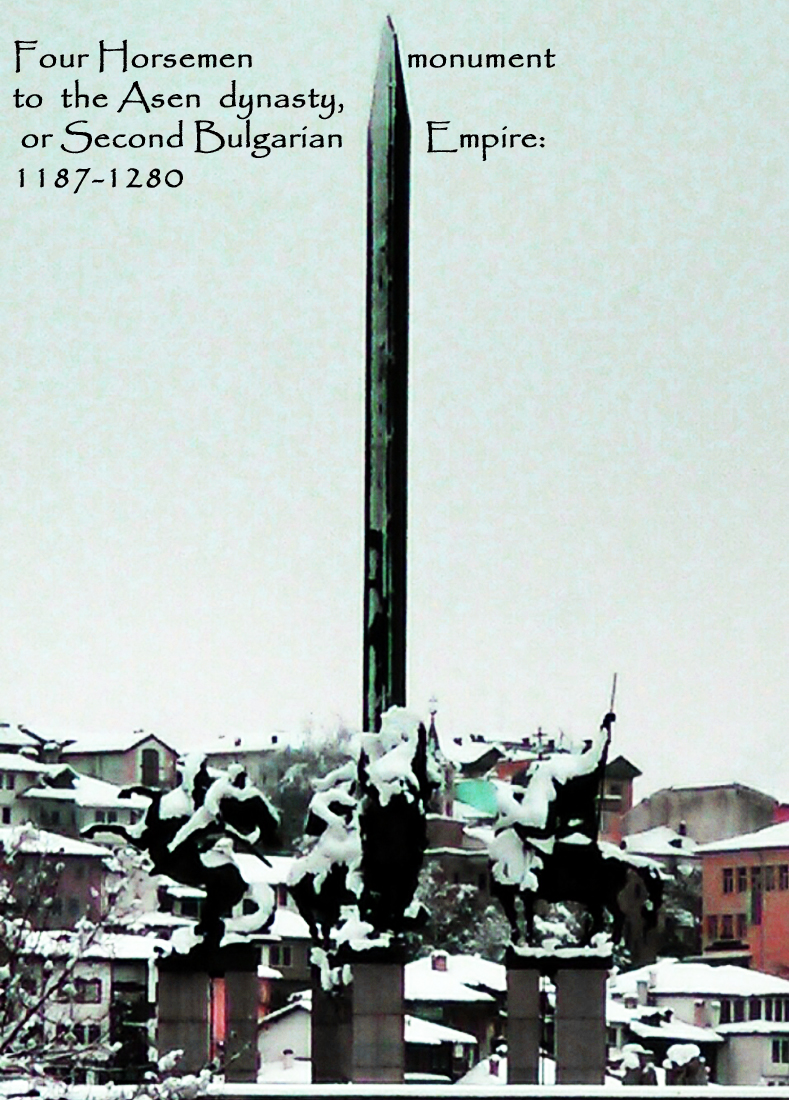
Here, as elsewhere in Bulgaria, we saw numerous monuments to those who sacrificed their lives in defense of the country, none in triumphant victory, although this one probably comes close.
We descended to lower elevations on our way to Plovdiv, late in the afternoon, but the weather remained cold and snowy. Nikola, our cruise director, warned us that we’d be staying a a hotel that was quite different from the other two: a Soviet-built hotel that’s now operated by Ramada. It was, of course, quite nice.

Archaeological sites in Plovdiv date back to the Neolithic Age–which may have had something to do with Plovdiv being chosen as the Bulgarian city to be the European Capital of Culture 2019. We saw excavations of Roman foundations across the street from the hotel and a War Memorial in a nearby park square.
We, however, devoted ourselves to family matters; which made Plovdiv the highlight of our trip.
Gary’s son Justin’s wife Diana is Bulgarian. They met when both lived and worked in Barcelona. We met Diana’s parents, Svetan and Sneja, at the wedding in Comprodon, a very old, picturesque town, high in the Pyrenees a couple of hours north of Barcelona.
 We do not speak Bulgarian, nor do they speak English. Svetan speaks a little Spanish and I a little Italian, but that doesn’t get us very far. They drove nearly three hours from Sofia and arranged for bring Lizi, a young family friend who speaks fluent English, to meet at our hotel. We told Nikola, our cruise director, that we’d be meeting family in Plovdiv and wanted to bring them to dinner at the restaurant where the tour group was dining. He said that would be fine–and, indeed it was.
We exchanged gifts, of course, and then Lizi was magnificent at translating conversations all evening. We four parents had a great time talking about future possibilities. And Gary and I greatly appreciated the opportunity to learn more about Svetan and Sneja and their lives under Communism. Neither joined the Party–though that decision significantly impacted their income. Svetan was a ship captain who spent years operating dredges on Siberian rivers to gather rock for use in road beds. He was later sent to operate dredges on the Tigris and Euphrates. Sneja observed that this left her at home alone for extended periods. She essentially raised their two daughters as a single parent.
 illuminate history
Diana, this is one of your most interesting travel blogs yet!