
illuminate history
Curiosity: forget “Cherchez la femme” (Look for the woman.) “Cherchez l’histoire.” (Look for the story.)
shake-down warm-up
Yes, I know I’m mixing my metaphors: last Saturday we took Annikin  out for the first little cruise of the season. Our excursion wasn’t anything ambitious: just up the Willamette as far as we could go–to Oregon City, where the locks to go around Willamette Falls no longer operate.
Gary’s been working on the boat for months, so she looks great. He’d put a few finishing touches on things Friday and took care of what seemed at first to be a problem with the fresh water pump. I turned on the faucet while we were underway. Only a few drips came out. Sigh. I shut off the pump switch and left the dirty lunch dishes in the sink. We knew there were restrooms at the marina and we’d planned to walk into town for supper anyway.
The weather was perfect. The trip was easy. And we had the outside of the municipal dock pretty much to ourselves. The pizza at Mi Famiglia was very good, too. And guess what? We turned the fresh water pump back on when we got back to the boat. It worked fine.

We discovered a second problem in the morning: both propane tanks were empty. So we hiked to Starbucks for coffee and took quite a long hike along the riverbank.
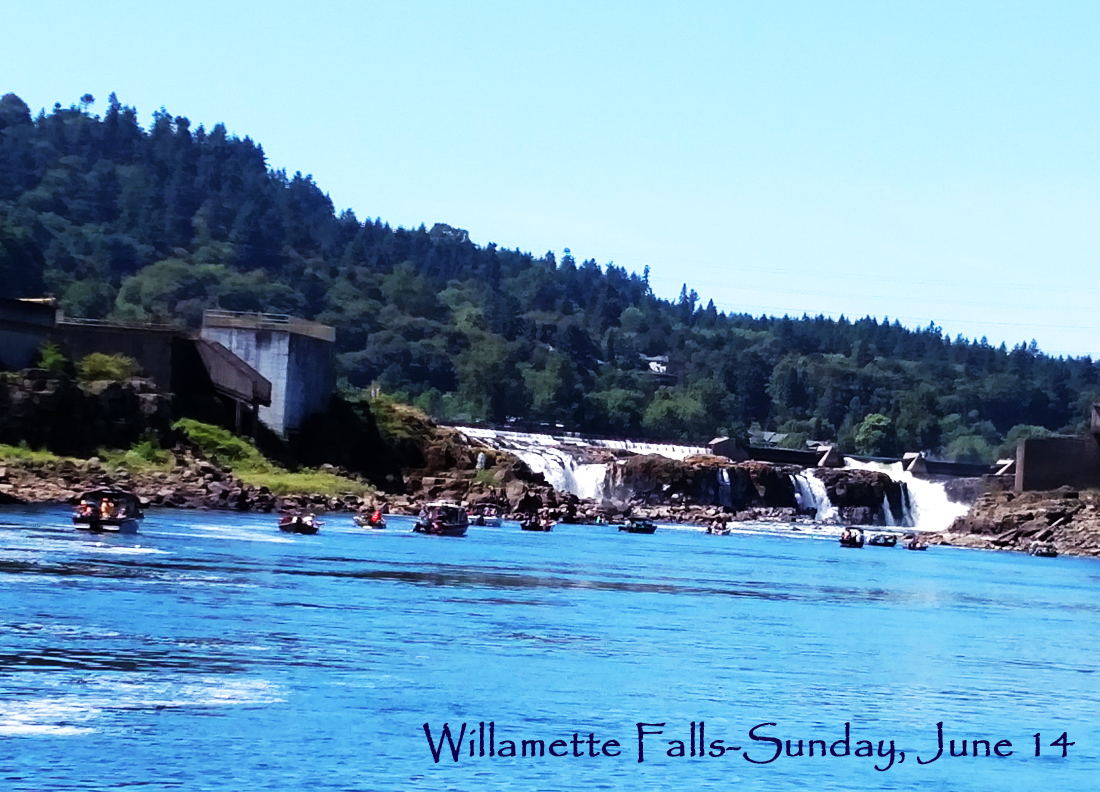
Before heading back toward Lake Oswego, we went closer to the Falls and all the fishermen lying in wait for Spring Chinook.
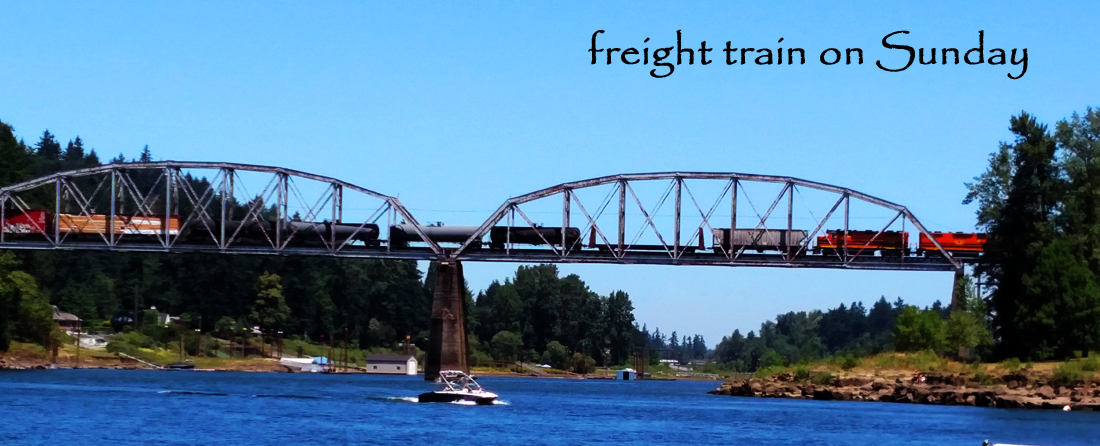
It was an easy trip down-river to the dock at Foothills Park in Lake Oswego, where, even on Sundays, freight trains cross the 1910 railway bridge in both directions. It was a short walk from Foothills Park to Manzana for a take-out order of fish tacos and Bay Shrimp enchiladas.

Railroad bridges have been on my mind quite a bit lately, but it took an hour or so for me to realize why this one seemed different: the trusses are on top of the tracks, not underneath, like the famous Haupt bridge across Potomac Creek.
It turns out, of course, that the same principle applies, whether above the tracks or below the tracks. According to the Random House Dictionary of the English Language, the primary definition of “truss,” in terms of Engineering and Building Trades, is “any of various structural frames based on the geometric rigidity of the triangle and composed of straight members subject to longitudinal compression, tension, or both…to support bridges, roofs, etc.”
One last note on resourcefulness: Monday morning I remembered that we have a 4-cup glass measuring cup on the boat. I used that to boil water in the microwave to make coffee in our thermal French press.
Gary re-filled the propane tanks on Wednesday.
 illuminate history