
illuminate history
Curiosity: forget “Cherchez la femme” (Look for the woman.) “Cherchez l’histoire.” (Look for the story.)
Pattern Recognition
My husband Gary suggests that it’s sheer vanity that drives my interest in representations of the goddess called Artemis by the Greeks and Diana by the Romans. I explain that my parents named me Diana, for the singer and actress named Deanna Durbin. I think my father liked her because she could sing opera.
I was an avid reader as a young girl, and read Myths Every Child Should Know by Hamilton Wright Mabie, as well as Bullfinch’s Age of Fable or Beauties of Mythology . I majored in literature in college, and took a course called Classical Mythology in Literature and Art. This is part of my recurring theme: I’m always looking for stories.
When we went to the 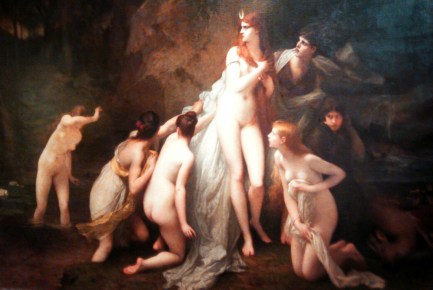 Museo Nacional de Bellas Artes in Buenos Aires this past February, I was quite fascinated by the collection of late 19th century French art donated by the family of a wealthy Porteño. In addition to a bronze bust and an oil portrait of the collector, there was a 9′ x 12′ painting of Diana Sorprendita (“Diana surprised at her bath”). That’s the story of Actaeon, the young hunter who accidentally comes upon Artemis bathing with her companions. He is smitten by her beauty. But “The Huntress” transforms him into a stag and he is hunted down by his own dogs for having the temerity to desire a goddess. Next to this large painting was a much more demure bronze bust of Diana.
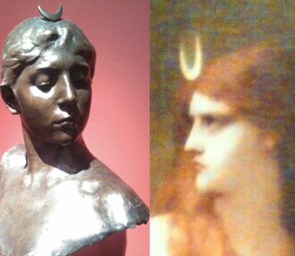
I made a little collage of the two faces and have been using them as my FaceBook cover photo:
So, fast forward from late February to December 18, when Gary and I go to the Portland Art Museum to see the wonderful exhibition of the Paul G. Allen family collection, called Seeing Nature.
On the way in, however, we stopped in the  entrance lobby to view another exhibition called Paradise: Fallen Fruit. Paintings hang on four walls. Assorted sculpture of different media and different types of people, representing, I think, both the audience who comes to view the art as well as the different peoples who came over the centuries to populate the Paradise of the Pacific Northwest.
One of the pieces was a bust of Diana that I recognized first from the crescent-moon decoration in her hair. As I looked at her from below, I became increasingly convinced that this one must be another cast of the bronze we saw in Buenos Aires.
Because the lighting is so different, the two pieces don’t look very similar, even side by side:
But I’m tenacious. Today , I found other photos from a more similar angle on the Portland Art Museum Web site and I discovered that both pieces are by the same artist: Jean Alexandre Joseph Falguière.
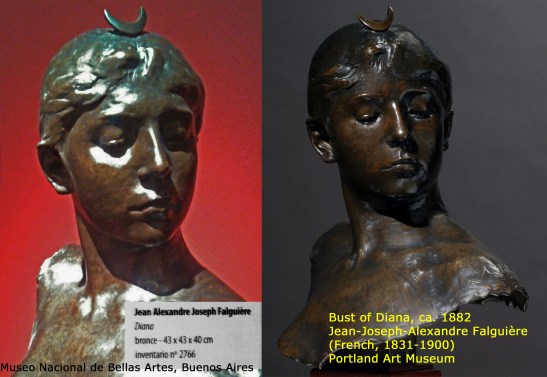
Pretty close, don’t you think?
 illuminate history
I think the Argentine Diana looks a little more “imperious”…
Hmmm-I should explore ancient Pamelas’.
Pam