
illuminate history
Curiosity: forget “Cherchez la femme” (Look for the woman.) “Cherchez l’histoire.” (Look for the story.)
Perspectives on Doors
We’ve watched the “Occupy ICE” encampment growing in our South Waterfront neighborhood for more that a week and planned to attend the demonstration announced for today. Mid-to late morning, we learned that the demonstration and speeches by several state representatives and Mayor Wheeler would be at City Hall. I went with a couple of neighbors. We stood in the peaceful, supportive crowd of several hundred, as several state representatives spoke forcefully to an enthusiastically receptive audience of the need to reunite asylum-seeking families, retain Oregon’s Sanctuary State status and abolish ICE–pointing out that customs and immigration laws had been enforced for over 150 years before ICE was created as an extra security measure after 9/11. They also noted that drug abuse, alcoholism and crime are much less prevalent in immigrant communities than the population at large.
We left when the band was announced and I went to Portland Art Museum to see a special exhibition of Minor White’s late 30’s/early 40’s photographs of Portland. Most were downtown commercial buildings, with special emphasis on late 19th cen. decorative ironwork, which was holding up better than the concrete walls it embellished.
 A couple of Victorian mansions (demolished in the 50’s) were featured in photos from 1942. The close-up of the decorative arch over the front door of the Jacobs-Dolch house caught my eye because I’d seen a somewhat similar image in a cast bronze door-knocker on the Greek Island of Idra, near Piraeus the port of Athens.
My curiosity piqued, I did some superficial on-line research, expecting to find that this was a prevalent image of a Greek household goddess. But the bronze image I saw three years ago resembles similar similar pieces identified as Dionysus and Bacchus.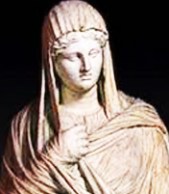
The demure Hestia was the Greek goddess of the hearth, a protective, sheltering virgin goddess. I’ve now realized that the decorations on the crown of the Idra door-knocker are grape leaves and grapes, not feathers and jewels.
 I looked for more images of fancy cast-bronze
  women’s head door-knockers, now thinking that the Bacchus image evolved into a more feminine version. This type of door-knocker became popular in Great Britain and the US during the Victorian era and replicas are available for around $100.
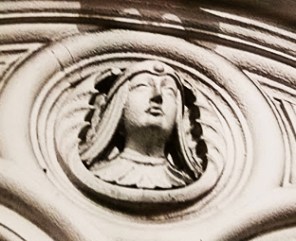 The image on the Jacobs-Dolch doorway arch may, in fact,
 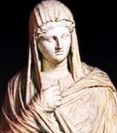 represent Hestia. Her eyes are modestly looking down, her headdress looks like the simple drapery that the statue wears and she seems positioned to offer a blessing, rather than announce the arrival of guests.
Once I began writing about these bizarrely disconnected subjects, I realized there is a common theme: doors need to be opened and provide shelter for all who enter.
 illuminate history
Loved this ! You really tied your Experiences together wonderfully.
Sent from my iPhone
>