
illuminate history
Curiosity: forget “Cherchez la femme” (Look for the woman.) “Cherchez l’histoire.” (Look for the story.)
Pattern Reproduction

It took a second try, but my questions were answered—and in a context that amplified the significance of what I learned.
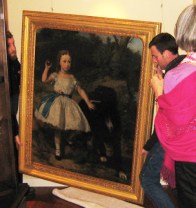
Director of Membership Lisa Hoffman referred me to curator Charles Campbell, with whom we’d worked to donate Adèle—the painting that got my novel started—three years ago. Charles remembered us, which was nice, and sent me a detailed article about French sculptor, Jean Alexander Falguière, 1831-1900.
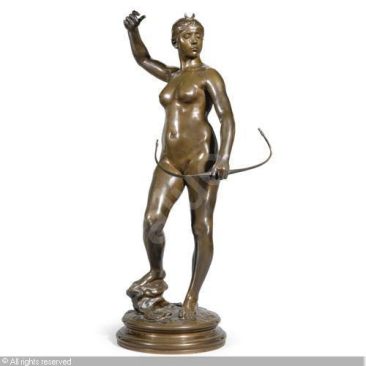
Falguière was at the height of his career and a renowned academic sculptor when he created a life-size, full-figured Diana in plaster “which he exhibited to great acclaim at the Paris Salon of 1882. Falguière’s statue portrayed Diana, in the words of the critic Geffroy, ‘boldly undressed, but shooting her arrow with a proud and disdainful glance under her lowered eyelids’.” I’m sure the original plaster figure no longer exists, but I’d guess that this bronze was cast from it. The image became so popular that Falguière created busts in three different sizes: images that flooded the market.
After Charles sent me the article and I’d found more examples on the internet, I encountered Bruce Guenther, former Portland Art Museum Chief Curator (with whom we also worked on our donation) at a performance of the recent Friends of Chamber Music Jerusalem Quartet Beethoven and Bartok Festival.
I showed Bruce some of the images that I had on my phone—figures that were very similar but one a little bit smoother or rougher or a different color metal than another. I asked him how this phenomenon occurred. His explanation was very simple: artists do not operate foundries. Falguière had to engage one or more to make bronzes of any of his creations. He could also sell the right to make a certain number of copies of his images to the foundries who would pay.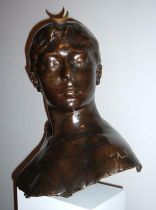
With three different-sized busts of Diana, Falguière had the opportunity to do this on a very large scale He sold the rights to produce, say, twenty copies of each one to many different foundries.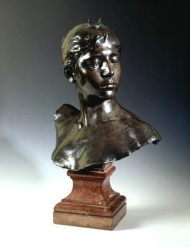
Malleable cast bronze figures emerged from fiery forges and skilled craftsmen used tools to enhance details—which is what accounts for slight variations among the many images.
Re-immersing myself in the Jerusalem Quartet’s brilliant interpretation of the full series of all six Bartok quartets and Beethoven’s opus 18, his first six quartets, it occurred to me that musical groups are foundries of a slightly different sort.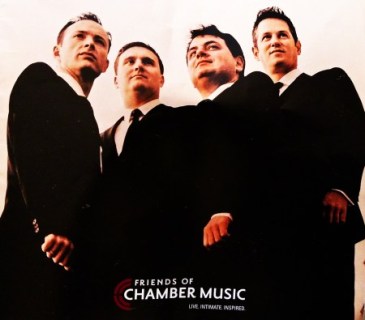
Composers create music by writing the scores. The music itself must be revived in each performance by musicians who are trained, like the craftsmen in the Parisian forges, to bring a work of art off the page and give it shape, color and life.
 illuminate history
Love the insight, Diana!